
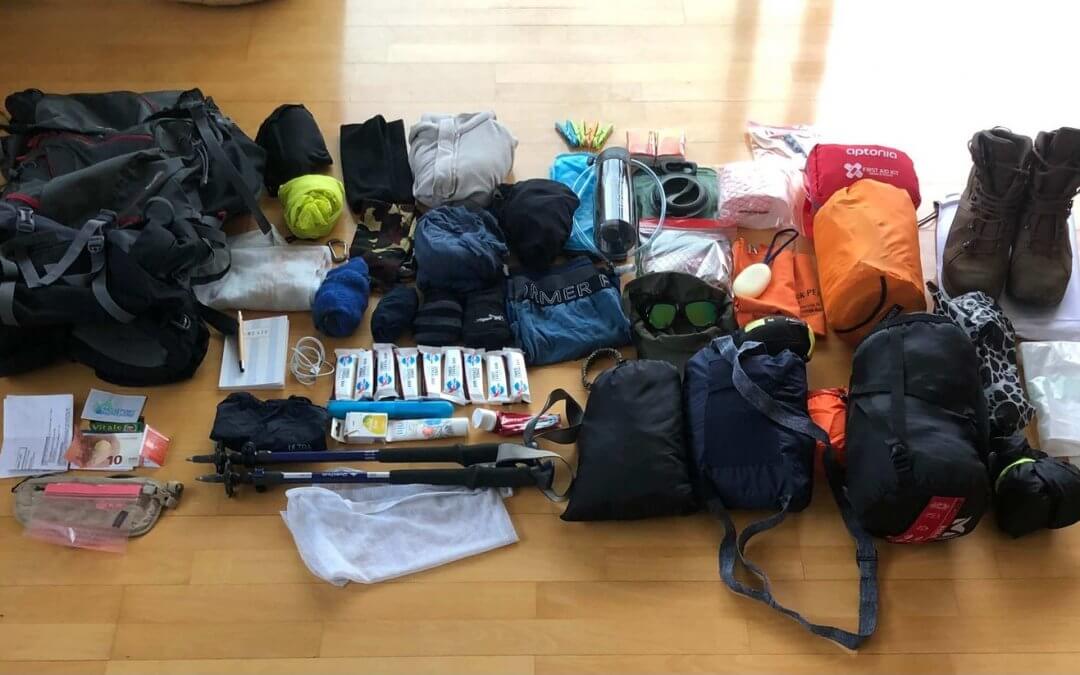
On the GR20, your kit decides how your days will go before you have even set foot on the trail. I have watched over-equipped walkers give up after three stages, ground down by kilos that served no purpose, and others, lighter and better thought out, swallow the ridges with a smile. Absolute priority goes to the rucksack and the footwear, and that is where you never cut corners. For the rest, sports shops and second-hand apps do the job perfectly well. Here is the checklist I genuinely recommend for a GR20 crossing in summer, the one I work through myself before setting off.
Clothing, in layers
In Corsica in summer, you expect heat and forget that at 2,000 metres the morning wind cuts, and that a storm can drop ten degrees onto your shoulders in half an hour. The answer comes down to one word: layers. You pile them on, strip them off, readjust as the altitude and the hour change.
What I take: a waterproof jacket and waterproof trousers, a fleece, a warm packable down jacket, three short-sleeved merino t-shirts that dry fast and still do not smell after three days, a pair of shorts and a pair of convertible trousers, thermal leggings kept for the nights, and three pairs of underwear. One small thing that changes your life inside a pack: a mesh stuff sack to separate your clothes, so you find everything without emptying the lot. For accessories, a cap, a neck gaiter and sunglasses, because on the pale slabs of the Cinto the glare is brutal.
Footwear: trail shoes or hiking boots?
This is the question my clients ask me most, and the one decision you cannot afford to get wrong. The answer depends on how long you plan to spend on the trail.
For a GR20 in seven days or fewer, I recommend trail shoes, light and flexible, which let you run between the boulders. The downside I have seen with my own eyes: they wear out fast on ground that shreds everything, and their life expectancy is short. For eight days or more, go for hiking boots with thick soles, and army-issue boots do the job very well. They give you support that lasts the distance and you will not have to replace them along the way. Either way, one non-negotiable principle: nothing new on the start line. Footwear that has not proved itself on your feet is a promise of blisters by stage two. Pack three pairs of hiking socks, one thick ski sock kept clean purely for sleeping, and a pair of flip-flops for the evening shower.
The rucksack and the sleeping kit
Your pack is your home for one to two weeks. Reckon on 50 litres if you are sleeping in refuges without a tent, up to 70 litres in full self-sufficiency with a tent and camping gear, bearing in mind that the tent and camping gear alone weigh 1.5 to 2 kilos. Around that, here is the base: telescopic poles, a head torch, a 2-litre bladder backed up by a one-litre bottle with Micropur tablets, a Swiss army knife with a built-in fork, and a liner to protect your sleeping bag. For sleeping, a bag rated comfort 5°C, a one or two-person tent and an inflatable mat if you are bivouacking. For hygiene and first aid, biodegradable multi-purpose soap, a microfibre towel, and a first aid kit with paracetamol, muscle balm and blister plasters.
A word on one item everybody underestimates: the power bank. On the GR20, sockets in refuges are rare and much fought over, and hundreds of walkers have the same need as you at the same moment. Watching your phone die when it doubles as your map and your camera is a small anxiety you can avoid for a hundred grams. Think about some cash too: certain refuges do not only sell groceries, they also bail out the unlucky walker with kit.
The golden rule on weight
It all comes down to one figure: never carry more than 20% of your body weight. Beyond that, it is no longer your legs doing the walking, it is your back taking the hit. A good pack sits on the hips thanks to the belt, never on the shoulders, with a slight gap between your back and the pack to let the sweat breathe. Use the outside pockets and the top straps to attach the tent or the mat and to stow the poles through the climbing sections.
The poles, while we are on the subject, are not a gadget. They account for roughly 25% of energy saved in the legs, and your poor knees will thank you on the endless descents in the north. Get them out of their packaging before Corsica and get used to their rhythm over a few outings.
The details that make the difference
It is the small things that rescue a stage. A big bin bag, or a 30-litre plastic bag, slipped around your sleeping bag while you walk: the day the storm breaks, you will not be sleeping in a soaked bag at 4°C. Three clothes pegs clipped to the pack to dry a t-shirt in the sun as you go. Earplugs, because a refuge dormitory at night snores in chorus. And a few energy bars for the low moments between refuges. One last useful reminder: on the GR20, wild camping is forbidden except in genuine emergency, so you sleep in a refuge, in a hired tent or in your own tent on the pitches provided.
That is the essential kit. The rest you fine-tune with use. To prepare for what comes next, read when to go, water and food and the budget. And if you want the full checklist, item by item, to tick off before every departure, it is in the free ebook “Get your GR Corse 100% right”.