
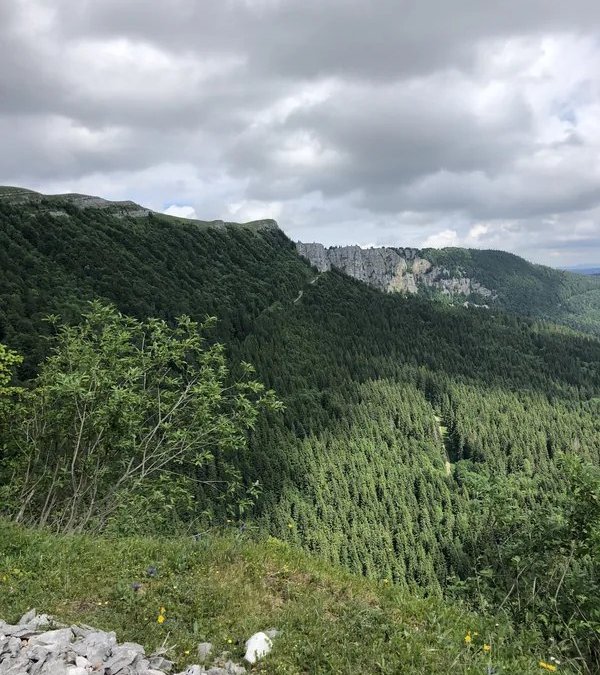
The first time you really kneel down in front of a mushroom, something shifts. You thought you were walking past it. Now you are looking underneath, smelling it, comparing the colour of the gills, the texture of the stem. The forest of the Jura, which you used to cross without paying it any attention, suddenly starts talking. That tipping point is what I try to bring about on every RandoSpores outing.
Observing rather than picking
Let me say it straight away, because it matters. On a RandoSpores, we do not pick anything to eat. The outing is devoted entirely to observation and identification. We look, we learn, we photograph, and we leave the forest as we found it.
That choice is not a restriction, it is a philosophy. Take the question of edibility away and your mind is free to really understand what is in front of you. You are no longer in a hurried forage, you are in a discovery. And paradoxically, you learn to recognise species far better when the goal is not to fill a basket.
Learning to look
Identifying a mushroom starts with learning to observe methodically. I point out the clues that count: the shape of the cap, whether it has gills, tubes or folds, the colour that sometimes changes when you touch it, the smell, the habitat it grows in, the tree it has settled at the foot of.
Little by little, the eye trains itself. What looked like an indistinct carpet of brown shapes becomes a mosaic of different species, each with its own logic. You start to anticipate, to tell yourself that under this kind of tree, in this sort of damp, you have a good chance of finding that family. It is a naturalist’s treasure hunt, and it is more accessible than you would think.
The role of fungi in the forest
A fungus is never on its own. It is connected to the trees, to the soil, to the dead wood, in a network that is discreet but essential. I like to take the time to explain that role, because it changes how you see. You come to understand that these organisms recycle matter, feed the trees, and hold the forest up in a way you cannot see.
After that, you no longer walk through a forest the same way. You see an ecosystem where before you saw only scenery. It is perhaps the thing participants tell me they keep longest after the outing.
An accessible outing, families included
RandoSpores is meant to be simple and slow. The ground is familiar, the pace is easy, and there is no fitness requirement. It is an activity that shares well with a family, with curious children who often make excellent observers. If the idea of nature at a child’s height appeals to you, have a look at a family nature outing in the Pays de Gex, in the same spirit of discovery.
When, how much, how
The mushroom season is short, and that is exactly what makes it precious. The outings are concentrated from the end of summer to the middle of autumn, when the forest of the Jura wakes up after the rains. Reckon on around €40 per person, in a group of up to about twenty participants, which leaves plenty of room for conversation.
Places go quickly in a window that narrow. So that you do not miss the season, you can join a RandoSpores outing and check the next dates on the dedicated page.
Walking in the Jura, differently
RandoSpores is a way into a forest you think you already know. If you love this landscape and this atmosphere, our guided hikes in the Jura will take you off to explore other sides of the range, from the ridges to the woodland.
To come home able to name three mushrooms you used to walk past without seeing is already to carry a piece of the forest with you. And it is often the start of a curiosity that never quite stops.