
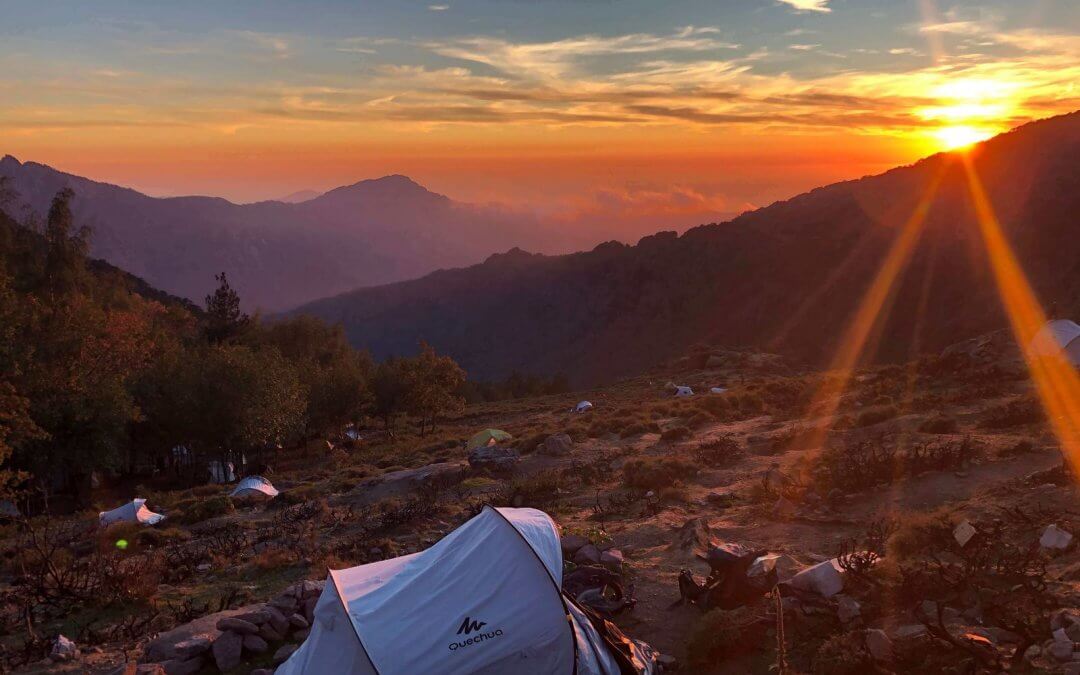
On the GR20, every stage ends at a refuge, often a handful of huts set down in the middle of the mountains, sometimes a full base like the one at Ascu Stagnu. A good part of how comfortable your crossing feels is decided there, and the choices you make about where to sleep change the experience completely. Here is how to find your way through it.
A refuge on every stage
The GR20 has a refuge on each of its stages, from the one at Calenzana at 275 metres to Conca at 250, by way of high points such as Ciottulu di i Mori at 1,990 metres or Petra Piana at 1,800. All of them are run by the Parc naturel régional de Corse, which you can contact at infos@pnr-corse.fr. These refuges never leave anyone outside. Even when full, there is always a solution.
Do you need to book?
You can book online or on arrival. During the July and August rush, booking ahead makes life easier for the wardens and spares you nasty surprises. Worth knowing: paying online often gets you better rates, but it ties you to fixed dates. Booking on the spot costs a little more and gives you a freedom nothing else matches, if you want to double up a stage or treat yourself to a rest day.
Dormitory or tent?
This is the central choice. A dormitory gives you the comfort of a real bed and the chance to swap stories with other walkers, but the places are in high demand and absolutely must be booked in high season. The tent, for its part, has some serious arguments in its favour.
- More peace and privacy
- You can book from one day to the next, so far more flexibility
- The freedom to double up a stage or ease off depending on how you feel
- A mattress provided if you hire the camp tent
- And, no small detail, no bed bugs
No tent of your own? You can hire one at the refuge, supplied with two mattresses but no sleeping bag. If the elements turn wild, rain, wind and cold, a night under canvas will inevitably be less restful. My advice: go with your own tent, while treating yourself to a few nights in a dormitory to recharge and dry the kit out.
Meal times
Something that catches people out in the first few days: everything has to be booked. Breakfasts start around 6.30am and are reserved the evening before with the warden, which matters when you want an early start to dodge the afternoon storm. For dinner, book as you arrive, and aim to reach the refuge before 3pm to be sure of a hot meal. Otherwise the refuge shop will see you right before it closes.
Bergeries and hotels
Between the refuges, the bergeries, the shepherds’ huts scattered along the route, are worth the detour, as much for the night as for the table. The GR20 is not just a hike, it is a culture too: saucisson at l’Onda, veal with olives at Ballone, entrecôte at Vergio, chestnut desserts at Matalza. On some stages reachable by road you will also find hotels, at the Ascu Stagnu complex, at the Hotel Castel Vergio, the highest in Corsica at 1,400 metres, or at Vizzavona. Exact contact details for the bergeries, which we do not publish here out of respect for their privacy, are in our free ebook.
To round it out, see when to go, the budget to plan for and the 16 stages in detail.