
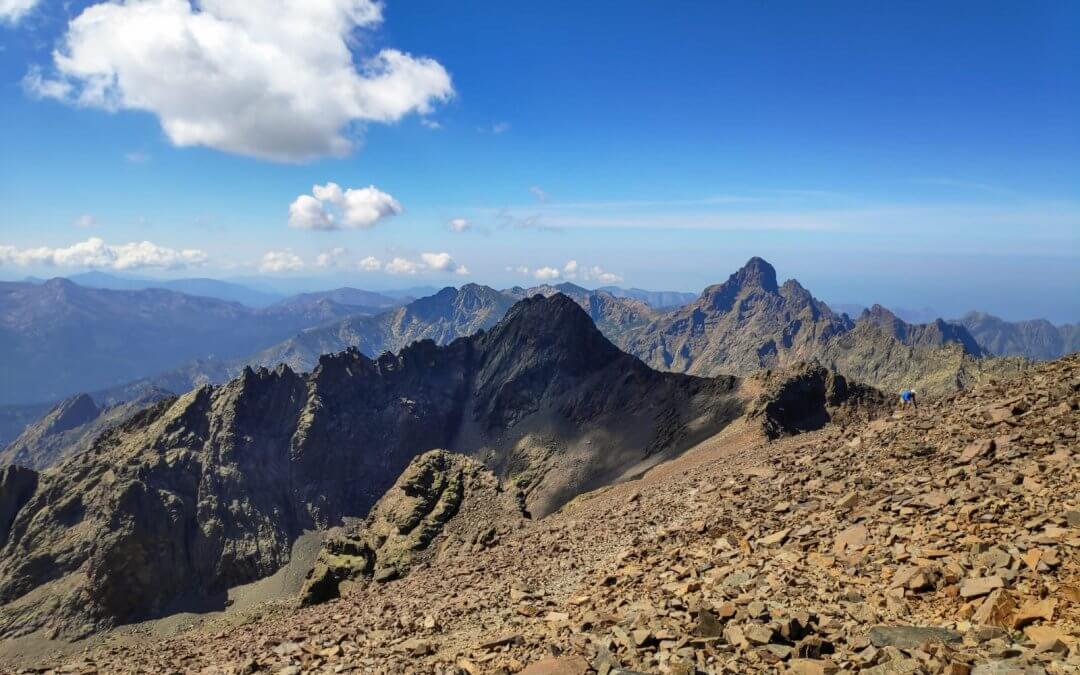
Every year around 20,000 hikers set off on the GR20, and only half of them finish. The other ten thousand give up, almost always for three reasons: not enough preparation, an injury, or not enough time on the route. Which means that before we even talk about kit or refuges, one question decides everything. How much time do you have, and what shape are you in? Preparation is not measured the same way depending on whether you are aiming for a contemplative GR20 crossing or a race against the clock. Here is how I see it, depending on the pace you choose.
The GR20 in 15 days: the unhurried version
If you are planning two weeks, you do not need titanic training. Good general fitness will do, as long as you listen to your body the whole way. One stage a day leaves time to take it all in, to talk with other walkers, to swim in the rock pools and to take long breaks at the bergeries for a taste of Corsican cooking. That is the pace I recommend for a first crossing, the one that turns the GR20 into a memory rather than an ordeal. Walk regularly in the months beforehand, get your shoulders used to carrying a loaded pack for hours at a time, and you will arrive in Corsica calm. The real trap in this format is not a lack of fitness, it is the fatigue that stacks up night after night. Between noisy dormitories and days run back to back, give yourself proper breaks.
In 11 days or fewer: you have to double up
Getting round the GR20 in eleven days or fewer means doubling up some stages, so walking more each day, often eight to eleven hours. At that point endurance becomes the priority. I would advise preparing your legs several months ahead: stringing together long 40-kilometre hikes so the doubled stages of around thirty feel manageable, training on chaotic ground of scree and loose rock so you are not discovering it in Corsica, and banking outings with more than 2,000 metres of ascent to get the legs and above all the feet used to that pressure. On the roughest sections in the north you sometimes move at barely a kilometre an hour. Keep that in mind so the real length of the days does not catch you out.
In practice, doubling up usually means linking two refuges in a row where most walkers stop at the first. On paper that is half as many nights. On the ground it is twice the demand, and the slightest twinge in a knee or a foot is paid for in full the next day. Doubling up is not something you improvise, it is a choice you build towards over months, not the night before you leave.
In 7, 5 or 3 days: challenge territory
The most athletic get round the GR20 in seven days, five, sometimes three. At that point the aim is no longer contemplation but performance, with ultra-trail level training and an ultralight pack that rarely tops two kilos: a one-litre bottle, something against the rain, the essentials and nothing else. That is a long way from the classic hiking packs that can climb to 18 kilos once loaded. For a benchmark, the records sit around 30 to 36 hours. For the men, Lambert Santelli covered it in 30h25 in June 2021, and for the women, Anne-Lise Rousset in 35h50 in June 2022. Bear in mind that these champions were not alone, a team went with them to manage the transitions and the recovery between sections. Even with that support, getting round the GR20 in under two days remains a titanic feat, and absolutely not something to aim for on a first attempt.
My final preparation tips
Whatever your pace, success comes down to details people often neglect. You are going to walk several consecutive days with the weight of the pack, altitude changes that affect your breathing, the small daily aches and a lack of sleep. Two habits change everything for your feet, your number one weak point: clean hiking socks, changed every day, and an anti-blister cream such as Nok applied daily, from the morning onwards. If the altitude leaves you short of breath, slow down and take more breaks, this is not a race. If your body is asking for rest, give it a recovery day in a refuge. A well-placed break always beats giving up. And above all, learn your limits. There is no point doubling or tripling stages if you are not in a state to set off again the next morning. The best preparation is the one that gets you to the finish, not the one that gets you there fast one day and out of it the next. To sharpen your plan, take a look at the 16 stages, à when to go and everything to pack before you go.