
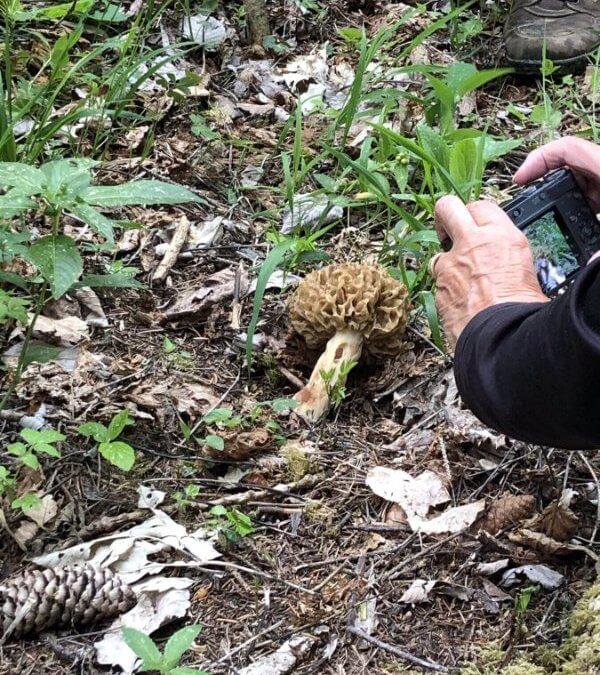
Picking mushrooms looks simple. That is exactly what makes some mistakes so common, and sometimes so serious.
Every autumn, in the woods of the Jura, I meet people delighted with their basket and others who have walked straight past fine finds or taken risks without realising it. Foraging is a wonderful pleasure, but it has to be learned. Here are the five mistakes I see most often in beginners. Some simply spoil the outing. Others are far more serious.
1. Trusting an identification app
This is mistake number one, and by far the most dangerous. Apps that identify a mushroom from a photo get it wrong on a regular basis, because a smell, a texture, the colour of the cut flesh or the base of the stem do not show up in an image. And those are often the very details that separate an excellent edible from a toxic look-alike. An app can help you learn. It can never decide whether you put something on your plate. No serious mycologist confirms a species from a photograph alone.
2. Mistaking a mushroom for its look-alike
Plenty of good edibles have a dangerous cousin that looks a great deal like them. A deadly amanita (Amanita) can pass for a harmless mushroom to an untrained eye. The beginner looks at the general outline and decides it looks about right, when the difference comes down to a ring, a volva at the base, a particular shade. Learning to see those details takes time, and it happens far better in the field, with someone showing them to you, than alone at home with a guidebook.
3. Picking everything, including what you do not know
Out of curiosity or greed, the beginner tends to fill the basket with everything that grows and sort it out later. Bad idea. A fragment of a toxic mushroom mixed in with the rest can contaminate the whole haul, and nothing replaces sorting done on the spot, specimen by specimen. The rule experienced foragers follow is simple. You pick only what you identify with certainty, and you leave the rest standing, where it carries on playing its part in the forest.
4. Using a plastic bag rather than a basket
It sounds trivial, and yet. In a plastic bag, mushrooms sweat, get crushed and ferment fast, which ruins the haul and can make it indigestible. A wicker basket lets the air circulate, keeps the specimens intact and, as a bonus, drops spores along the path, which helps the forest renew itself. It is a small thing, but it is the difference between a respectful forager and someone in a hurry.
5. Forgetting that there are rules
Foraging is not an unlimited right. Depending on where you are, quantities are regulated, some forests are private, and you have to respect the habitats you walk through. Ignoring those rules means risking an unpleasant surprise and, above all, helping to exhaust fragile spots. Finding out what is allowed where you are going is part of the basics, just as much as knowing how to recognise what you pick.
The good news is that none of this is beyond reach. Nobody is born a forager. You become one, season after season, by learning to observe and by accepting that you will have doubts. The best pickers I know are precisely the most cautious ones, the people who leave standing anything they are not sure about. Avoiding these five mistakes already puts you on the right side, the side of quiet pleasure rather than pointless risk. The rest comes with practice and good guiding.
You will have gathered that most of these mistakes come from the same starting point. People think it is enough to look, when what you need is to learn to see. That is exactly what we do on a RandoSpores. We move slowly through the woods of the Jura, we observe, I show you the details that matter, and we never eat anything. The point is not to fill a basket, but to come away with a real eye. Everything is explained on the RandoSpores page, and to go further on the dangerous mix-ups, read the five toxic look-alikes to know in the Jura.
On the same subject
- Toxic mushrooms of the Jura: 5 look-alikes to know
- A family mushroom outing in the Jura
- The overlooked role of mycelium in the forest
Want to learn to see rather than to pick?
On a RandoSpores, we head out to observe and identify the mushrooms of the Jura together, safely and without eating anything. Join the RandoSpores WhatsApp group to get the next dates of the season.