
Behind the GR20 there is a history, an enormous reputation and a fair few received ideas. Every summer, thousands of walkers set off on this trail that has become the stuff of legend, drawn as much by its myth as by its landscapes. Three questions come up constantly when people are preparing this crossing : where does that slightly mysterious name come from, does it deserve its title of finest trail in Europe, and is it really the hardest? Here are my answers, with no myth-making and no false modesty.
Why GR20?
The letters GR simply stand for Grande Randonnée, the white and red waymarked routes that criss-cross France. The Corsican trail has a far more poetic original name, Fra Li Monti, which means through the mountains, and that is exactly what it does: it crosses the island from end to end along the ridges. But why 20? The answer lies in an old piece of administrative logic. In the 18th century, in France, the départements were numbered in alphabetical order, and 20 was Corsica’s old number. In 1976, that 20 gave way to 2A for Corse-du-Sud and 2B for Haute-Corse. Yet the trail had been opened to walkers along its full length a year earlier, in 1975. The name GR20 was already out there, and it stuck, like a small trace of the island’s history frozen into two digits.
Today the trail is managed and maintained by the Parc naturel régional de Corse, which looks after its refuges and its waymarking. They are the people to contact for any question about bookings or the state of the route, and it is partly thanks to that work on the ground that the GR20 stays walkable despite terrain that puts it through the mill every year.
The finest trail in Europe?
Without question it is a magnificent route: the Corsican mountains are breathtaking, and few trails offer that contrast between the sea glimpsed in the distance and the high mountains underfoot. But calling it the finest trail in Europe remains entirely subjective. In my experience the mountains of the Jura, the calanques of Marseille or the ridges of Savoie, to stay in France alone, also offer trails that take your breath away. What is certain is that the GR20 has to be earned, and that its beauty is savoured all the better for giving it time. In eleven days or more, you take the time to swim in the rock pools, to taste the food at the bergeries and to enjoy the warmth of the people who live there. In seven days or fewer, performance takes over, and it becomes harder to truly enjoy the landscape.
North and south: two faces
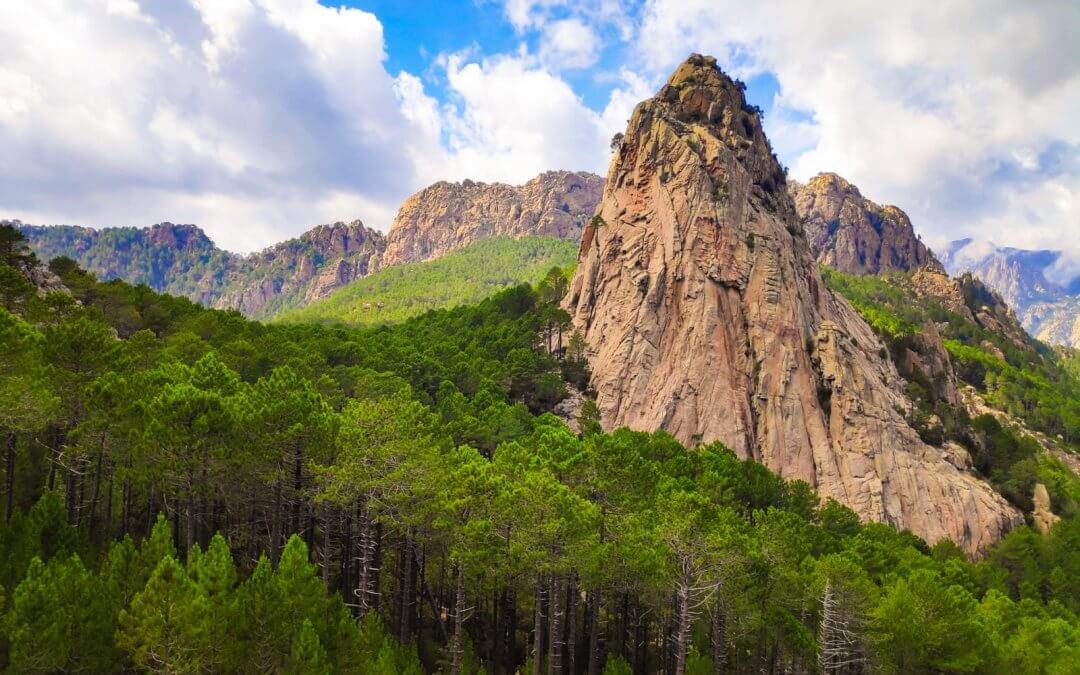
Part of the fascination comes from the way the GR20 changes face completely along the route. The north is mineral, raw, almost vertical: granite needles, slabs, sections where you use your hands, and scenery that turns almost lunar around Monte Cinto, the highest point on the island. The south softens into pine and beech forest, grassy ridgelines and bergeries where you get your breath back. And around a bend in the route, unexpected pictures: the jagged needles of Bavella, the emerald rock pools, or Lac de Nino with its pozzines, which take on the air of an Irish Connemara set down in the middle of the Mediterranean. Walking the GR20 means living those two moods one after the other, and plenty of people come away with a soft spot for one or the other.
And the hardest in Europe?
That is the GR20’s other great reputation, and here too it needs qualifying. Yes, it is a genuine challenge. But in good conditions it is hardly harder than a Tour du Mont-Blanc or a GR10 in the Pyrenees. What makes it demanding is not one single difficulty, it is the accumulation: highly changeable weather, technical northern stages where you sometimes put your hands to the rock, one short night after another and the fatigue that settles in as the days go by. Well prepared and well guided, it stays perfectly accessible to a motivated walker. Put plainly, its difficulty is real but it can be tamed: it punishes a lack of preparation far more than a lack of level. I say more about it in the article on the GR20 alone or guided, where I separate the truth from the fantasy.
One last word
As on any Alpine hike, beauty never excuses a lapse in vigilance. Dawdling, carelessness and scree make the trio that turns a beautiful landscape into a bad fall. Look up to admire it, but bring your eyes back to your feet regularly. A name inherited from history, a beauty that has to be earned, a difficulty that has to be prepared for: that, stripped of legend, is what the GR20 really is.
To prepare your crossing in practical terms, read the 16 stages, when to go and the budget.