
There is a sound I do not forget. A sharp, hoarse bark, almost a dog’s cry, somewhere in woodland I have just crossed on snowshoes. You see nothing. You only hear that, once, then the silence returning and snow falling from the branches. For a long time I took that sound for a missed encounter. It is a bill.
That roe deer was disturbed and forced to flee. It announces it as it goes. And what it has just spent getting away from me, in the middle of February, is not easily recovered.
Six times, ten times, sixty times
Yet the chamois is the best equipped of our hoofed animals for snow. It has an interdigital membrane, a web of skin between its two hooves, that acts as a natural snowshoe. It sinks less than the ibex, and much less than the roe deer.
A study by Mattfeld, Geist and Moen measured what moving over snowy ground costs it. In fifty centimetres of snow, walking takes six times more energy than on dry ground. Fleeing in the same conditions, about ten times more. And add a ten per cent slope, and the same escape costs sixty times more than normal movement.
Sixty times. For an escape that lasts thirty seconds and that you may not even have seen. Above all, remember that these figures concern the best equipped species of the lot.
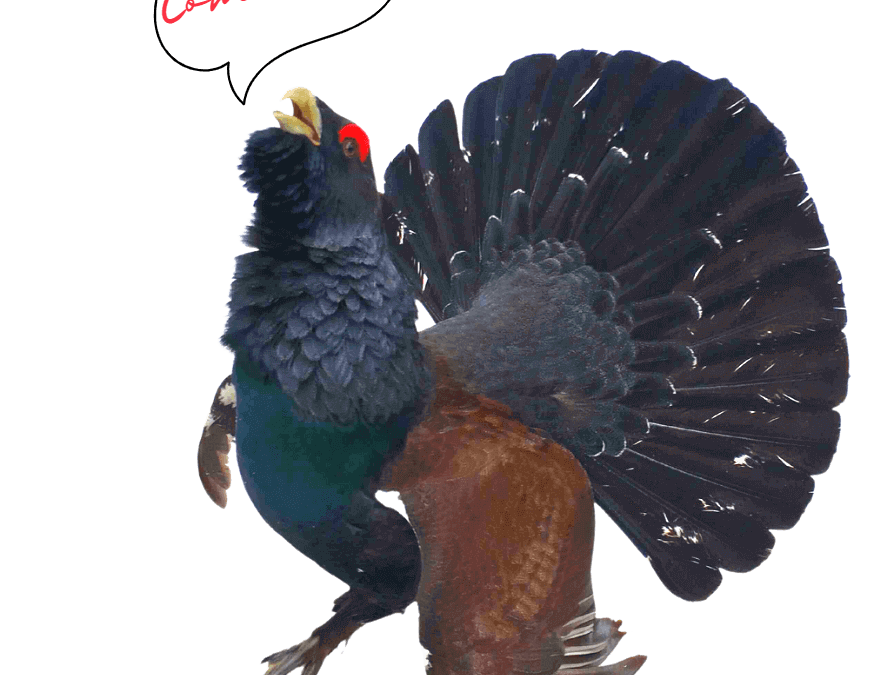
The black grouse and its 120-gram crop
The black grouse feeds only twice a day, morning and evening, for two to three hours in all. The rest of the time it rests in an igloo it digs in powder snow. Its crop, the pouch where it stores what it swallows, holds about one hundred and twenty grams of food.
On a day at minus twenty degrees, its energy expenditure for simply normal activity equals eight hundred and twenty-five grams of food. Almost seven times what its crop can hold. It cannot find that much, let alone digest it, so it draws on its reserves. That is the sum for a day when nobody disturbed it.
It gets worse. The snow of its igloo insulates against cold, but also against sound. It only hears danger a few metres away. Sometimes it only takes off once someone has stepped on its shelter.
Fleeing is only the visible part
This is the point that surprised me most in training. We think we disturb an animal when it runs. In fact, from the moment it sees us it is on alert, and that state has a cost. An animal that does not move as you approach is not a calm animal.
The consequences of a disturbance make a list: stress, extra energy spent moving, the risk of accident while fleeing, abandoning one site for another that may be less favourable, having to build a new shelter, and the risk of being caught by a predator on leaving its hiding place. A single passer-by can trigger all of it.
Why it does not always run
In winter, in the rare areas where food remains within reach, animals shorten their flight distance. They do not want to leave the precious spot. We then think they tolerate us. It is the opposite: their stress rises as we approach, and they end up bolting at the last moment in a panicked run, instead of moving away calmly.
The rock ptarmigan and the mountain hare have a very short flight distance for another reason. White on white, they believe they are invisible. They only leave at the last instant, and then find themselves in the open in broad daylight, exactly what they spend the winter avoiding.
The one that pays the highest price
The roe deer. Slender legs, small size, no adaptation to moving through snow. Its biggest winter problem is simply getting around. And its highest mortality comes at the end of winter, when it is already very weak. Heavy, late snowfalls are extremely harmful to it.
The ibex plays a different tune, the reverse of all the others. It stays high up, on ridges the wind clears of snow, where food is scarce. So it has to move a lot to eat, which forces it to eat more, which forces it to move again. Its winter energy balance is irredeemably negative. Without plentiful fat reserves, it does not survive the season.
What this changes on the ground
None of this stops you going out. It changes how you go out, and it comes down to five simple things.
- Stay in existing tracks. Following a route already in use always does less harm than breaking your own trail in untouched ground. It is the easiest measure to apply, and the one that matters most after heavy snowfall or in very cold weather.
- Prefer open ground to woodland. You see and are seen from further away. No surprise, and the animal has time to move aside calmly instead of bolting.
- Let it go. If you meet an animal, stop and give it time. A panicked escape costs ten times more than a calm retreat, literally.
- Respect the protected wintering zones. These are sensitive wintering areas, marked with posts or flags, set up by the departmental councils and nature parks. Most concern the black grouse. Ask the park or department responsible for the area.
- Dogs on a lead, or at home. Even with no bad intent, a dog moves over snow better than any hoofed animal. The chase is unfair from the start.
At WhyTrek
Dogs are not allowed on my outings. The rules in the Haute Chaîne du Jura are stricter than most people imagine, and I have set out, area by area, what is prohibited, where and when, in dogs and hiking in the Haute Chaîne du Jura.
For the rest, the route is decided in the morning, depending on snow depth, temperature and the time of winter. That is the principle of the disturbance scale taught in training: you assess the day’s level of risk, identify the most vulnerable species in those conditions, and avoid its habitats. Guided hikes make that kind of judgement possible, because someone has made it before setting off.
On the rules, the quiz on what the law says when you hike covers protected wintering zones, biotope orders and nature reserves in thirty-two questions. To go further on the species themselves, wildlife and plants of the Haute Chaîne du Jura presents what lives here. And the quiz on Jura wildlife in winter goes over these figures in thirty-two questions, from the roe deer to the ptarmigan. And if the snow mostly makes you want to read who passed before you, recognising animal tracks in the snow is the beginner’s guide.
To walk on snow without disturbing anyone, I take you snowshoeing in the Jura from December to March, well away from the quiet zones.
Sources
- Learning booklet “Les difficultés de la faune en hiver” (wildlife’s difficulties in winter), from the Hiver sauvage, montagne en partage teaching kit designed by Sempervirens and Belledonne en Marche.
- Study by Mattfeld, Geist and Moen on the energy consumption of the chamois on snowy ground, cited in that booklet.
- Knowledge sheets no. 8, consequences of a disturbance, and no. 9, flight distances, from the same booklet.